Payments
How to Set Up a Decentralized Cloud VM with Aleph CLI
Deploy a decentralized VM in 10 minutes with Aleph Cloud's Rust CLI. Install, fund with USDC/ALEPH, launch Ubuntu instances for ~$10/month, and SSH in. No Python, no centralized cloud.
10 min. read -
With the deployment of aleph-vm 1.0.0 client, we are glad to announce the release of Confidential Virtual Machines on Aleph Cloud.
The biggest challenge to date was to deploy Confidential Virtual Machines. These decentralized virtual machines leverage cutting-edge hardware-based encryption to ensure that your data and applications remain fully protected, even during processing.
By deploying Confidential VM instances on Aleph Cloud, you unlock the following key advantages:
This level of security is achieved through a Trusted Execution Environment (TEE), ensuring true data confidentiality across decentralized infrastructure. Enable Confidential VM service easily when setting up your Aleph Cloud virtual machines for enhanced privacy and security.
Feature
Virtual Machines (VMs)
Confidential Virtual Machines (CVMs)
Data Security
Standard security, data may be exposed during processing
Hardware-based memory encryption ensures data confidentiality during processing
Encryption
Typically applied to data at rest or in transit
Encryption extends to data in use (while being processed in memory)
Isolation
Basic isolation through the hypervisor
Full isolation with encryption keys inaccessible to the hypervisor
Trusted Execution Environment (TEE)
Not available or optional depending on the platform
Utilizes a TEE to secure execution and ensure the integrity of sensitive operations
Attestation
Not generally available
Provides attestation to verify the VM’s identity and integrity, ensuring it hasn’t been tampered with
Use Case
General-purpose workloads, less focus on sensitive data protection
High-security workloads requiring data confidentiality during execution
Threat Model
Focuses on protection from external attacks
Protects against internal and external threats, including privileged users or compromised hypervisors
Performance
Standard performance
Slight performance overhead due to encryption and TEE mechanisms
Availability
Widely available on most cloud platforms
More specialized, requires specific hardware support for confidential computing
Deployment Complexity
Straightforward deployment, often pre-configured in cloud platforms
Similar deployment process with added configuration for confidentiality features
The table highlights the key distinctions between standard virtual machines and confidential virtual machines, focusing on enhanced security features that make CVMs suitable for sensitive data processing.
This aids in protecting the confidentiality of your data even if a malicious VM finds a way into your VM’s memory, or a compromised hypervisor reaches into a guest VM.
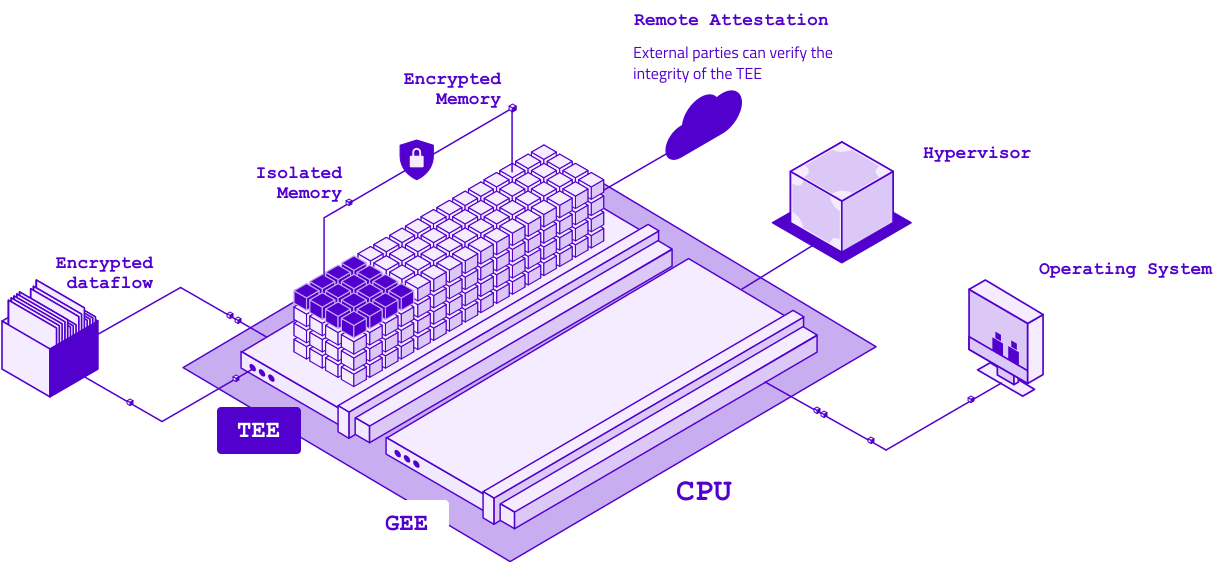
The Confidential VM labeled as beta, only means that not all node operators are able to provide such technology.
Payments
Deploy a decentralized VM in 10 minutes with Aleph Cloud's Rust CLI. Install, fund with USDC/ALEPH, launch Ubuntu instances for ~$10/month, and SSH in. No Python, no centralized cloud.
Computing
Aleph tokenomics introduces a dual-stream rewards model for decentralized cloud operators: a transitional reward floor plus a usage-based revenue share.
Payments
Pay As You Go and Holder Tier payments are officially deprecated. Aleph Cloud now runs on a single credit system. Top up with USDC, fiat, or ALEPH and pay for what you use.
Virtual Machines
Explore how OpenClaw AI agents, and Aleph Cloud’s decentralized AI Supercloud are redefining autonomous computing with sovereign, censorship-resistant infrastructure.